

How do you get employees to take part in a health check? Gezond-Werken brings the screening to the workplace, with cholesterol and glucose results discussed on the spot.
Half past seven in the morning, a meeting room at an employer’s site. The Gezond-Werken team sets up a temporary screening station. Half an hour later, the first employee walks in, in his work clothes and with a full schedule. He has thirty minutes for the examination; after that, he goes back to work.
“In those thirty minutes, we want to tell him something he didn’t yet know about his own health,” says Rik. “Not in two weeks. Now.”
What does Gezond-Werken do?
Gezond-Werken comes to the company, sets up a screening station in about half an hour and sees around seventeen employees on an average screening day. During the examination, the team measures:
- blood pressure and body composition
- grip strength and lung function
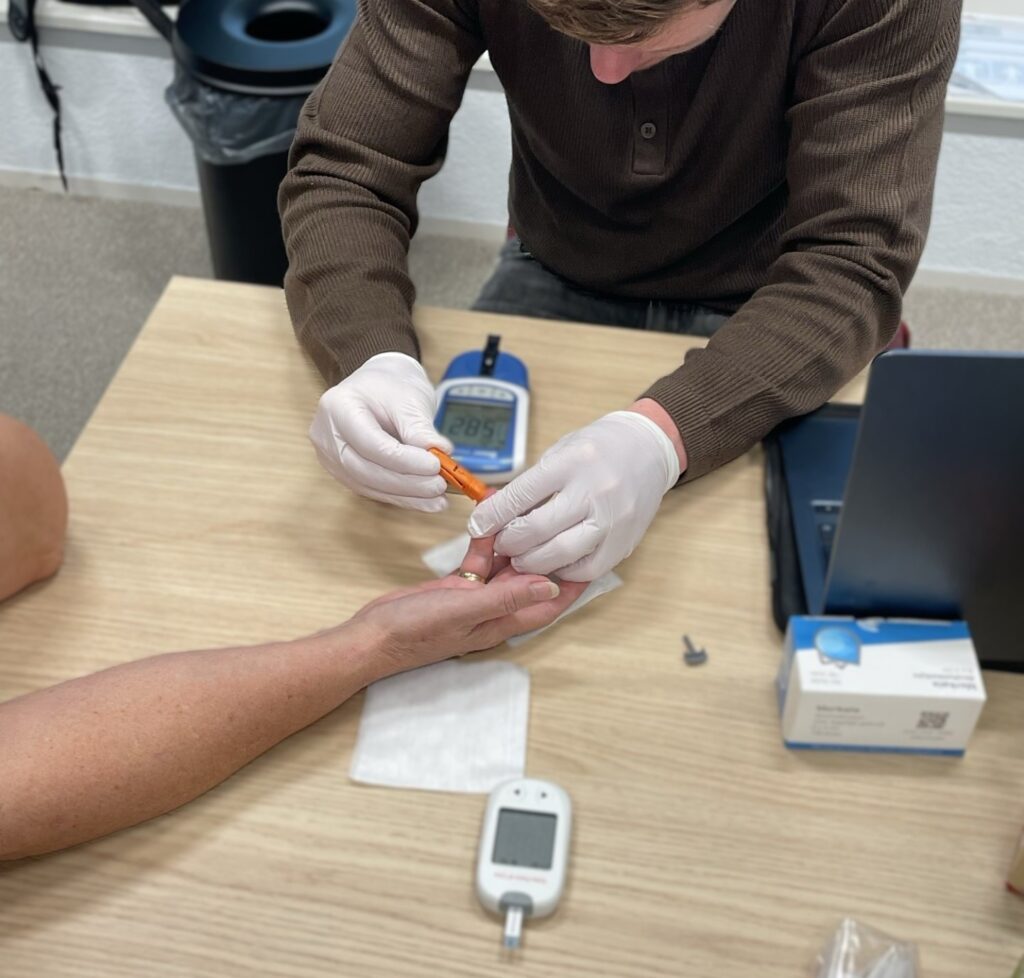
- cholesterol and glucose, with a finger prick
The measurements are taken by healthcare professionals with a completed degree in physiotherapy or nursing.
Every participant receives a personal report the same day. The employer later receives an anonymous group report showing the picture of the whole group. Individual results are not shared with the employer.
Why workplace health screening on location?
“Because otherwise people don’t come,” says Rik. “An employee who has to take half a day off for a health check keeps putting it off. If we’re twenty metres from where he works, he drops in between two jobs.”
According to Gezond-Werken, you can see this in the turnout and in who comes: including employees who would not easily make an appointment on their own.
Why results on the spot?
When blood is sent to a laboratory, the employee has long been back at work by the time the result comes in. “He then asks the question ‘what does this mean for me?’ to no one,” says Rik.
That’s why Gezond-Werken works with point-of-care meters, which give the result at the screening location: the Mission 3-in-1 for cholesterol and the SPoC Extra for glucose. The healthcare professional discusses the result in the same conversation, and anyone with a value outside the normal range gets advice on a possible next step.
“A number on paper changes nothing. A number someone explains to you face to face sometimes does.”
— Rik Hoogendoorn, Gezond-Werken
A screening result is not a diagnosis. It is information that is interpreted in the context of the individual and, where necessary, followed by further medical assessment.
Do employees need to come fasting?
Gezond-Werken hears this question almost every time. On its regular screening days, the team does not routinely ask participants to come fasting. “We do note whether someone has eaten, so we can read the result correctly,” Rik explains. “People who have to arrive fasting at half past seven cancel more often.”
Food intake can influence certain values, particularly glucose and triglycerides. Whether fasting is needed depends on the purpose of the examination, the test protocol and the manufacturer’s instructions. Sometimes an additional measurement on an empty stomach is necessary.
What has Gezond-Werken learned?
The finger prick is often the most nerve-racking moment
“Not the result, but the prick,” says Rik. “People who don’t flinch at heavy physical work sometimes go quiet for a moment when the lancing device is on the table.” A calm explanation helps, and so do warm hands: anyone who has just come in from outside, the team lets sit down for a moment first.
The conversation is the real work
The measurement itself takes very little time. The rest of the half hour goes to explanation: what a value says, what someone can do about it themselves, and when it’s wise to have things looked at further.
Measuring without follow-up is only half the job
“An employer who just puts a report in a drawer gets little out of it,” says Rik. That’s why Gezond-Werken always discusses the group report with the employer, to look together at what is needed.
What does an employer get out of it?
A group picture that shows where attention may be needed. If a large part of the group has raised cholesterol, for example, the employer can direct the vitality budget there: a nutrition workshop, a lifestyle programme or healthier lunches in the canteen. Without ever seeing an individual result.
Want to know more about Gezond-Werken?
Curious what such a day would look like at your organisation? On the Gezond-Werken website you can read how preventief medisch onderzoek op locatie (on-site preventive medical examinations) works, from the first meeting to the group report.
Written by Swiss Point of Care & Rik Hoogendoorn, Gezond-Werken · Last updated: November 17, 2026