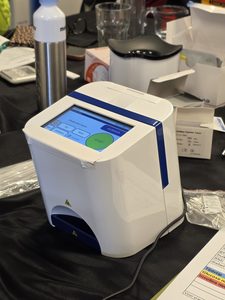


For step-by-step instructions, setup videos, warranty registration, and general user guidance, please refer to:
Cholesterol Monitoring – User Guides, Support & Technical Information
Technical summary (at a glance)
Mission® 3-in-1 Cholesterol Monitoring System
- Measured parameters: Total Cholesterol (CHOL), HDL, Triglycerides (TRIG)
- Calculated values: LDL cholesterol and CHOL/HDL ratio
- Sample types: Capillary whole blood, venous whole blood, serum, heparinised plasma
- Sample volume: 35 μL (3-in-1 lipid panel)
- Measurement principle: Timed end-point reflectance photometry (635 nm)
- Calibration: Automatic via code chip supplied with each test device lot
- Intended use: Point-of-care cholesterol monitoring (professional use and self-testing)
- Quality control: Internal system checks + external control solution testing
- Regulatory status: CE0123, in-vitro diagnostic medical device
If results appear unexpected or inconsistent, a control test should be performed before repeating a blood measurement.
Intended use
The Mission® Cholesterol Test Devices are used with the Mission® Cholesterol Meter to measure lipid concentrations in human specimens.
- For in-vitro diagnostic use only
- For professional use and self-testing
- Supported specimen types:
- Capillary whole blood (finger-prick)
- Venous whole blood (heparinised or EDTA)
- Serum
- Heparinised plasma
The 3-in-1 test device measures:
- Total Cholesterol (CHOL)
- High-Density Lipoprotein (HDL)
- Triglycerides (TRIG)
Based on these measured values, the meter automatically calculates:
- Low-Density Lipoprotein (LDL)
- CHOL/HDL ratio
Calculated LDL values are estimates and must be interpreted in context .
How the Mission 3-in-1 test works
Measurement principle
The Mission® Cholesterol Test Devices use a timed end-point reflectance photometry method.
- Enzymatic reactions occur on the test device
- The system measures changes in reflectance at 635 nm
- The change in absorbance is proportional to lipid concentration
- LDL cholesterol is calculated automatically using validated formulas when triglyceride levels are within the valid range
Calibration
Calibration is performed automatically using the code chip supplied with each lot of test devices.
- No manual calibration is required
- Always ensure that the inserted code chip matches the test device lot number
- Incorrect coding may lead to inaccurate results
Calibration via code chip is a critical part of ensuring measurement accuracy and consistency.
Measurement ranges
- Total Cholesterol (CHOL):100–500 mg/dL (2.59–12.93 mmol/L)
- HDL Cholesterol:15–100 mg/dL (0.39–2.59 mmol/L)
- Triglycerides (TRIG):45–650 mg/dL (0.51–7.34 mmol/L)
Values outside these ranges are displayed as “<” or “>”.
When results fall outside the valid range, calculated LDL cholesterol and ratios are not reported.
Accuracy, precision, and performance
The performance characteristics of the Mission® 3-in-1 Cholesterol Monitoring System have been established through laboratory evaluations, clinical method-comparison studies, and ongoing external quality assessments. The system is designed to support reliable cholesterol monitoring and consistent performance over time when used according to instructions.
Precision (repeatability)
Precision studies were performed using venous whole blood samples across low, medium, and high concentration levels.
- Typical coefficient of variation (CV%) ≤ 5% for
Total Cholesterol (CHOL), HDL cholesterol, and Triglycerides (TRIG)
These results demonstrate stable repeatability and support use in repeated monitoring and professional screening environments.
Accuracy (method comparison)
Accuracy was evaluated by comparing results obtained with the Mission® system against recognised laboratory reference methods using venous whole blood, plasma, and serum samples.
- Correlation coefficients (R): typically 0.99–0.998
- Strong agreement observed across the full measurement ranges for CHOL, HDL, and TRIG
These findings indicate that measured values correspond closely with laboratory reference methods when the system is used correctly and within its intended use.

Calculated LDL cholesterol
Low-density lipoprotein (LDL) cholesterol is calculated automatically by the meter based on measured Total Cholesterol, HDL cholesterol, and Triglycerides.
- LDL values are calculated only when triglyceride concentrations are within the valid calculation range
- Calculated LDL values are estimates and should be interpreted in clinical context
Calculated values are intended to support monitoring and trend observation and do not replace laboratory diagnostics.
Independent external quality verification (Swiss Ringversuche)
In addition to internal quality controls and manufacturer validation, the Mission® 3-in-1 Cholesterol Monitoring System is subject to independent external quality assessment through regular Swiss Ringversuche.
Swiss Point of Care participates in quarterly external quality control programmes organised by an ISO/IEC 17043-accredited Swiss quality control institution. These Ringversuche assess measurement performance by comparing results against defined target values and accepted tolerance ranges under standardised conditions.
Recent Ringversuche results demonstrate:
- Very good agreement with assigned target values
- Deviations well within established QUALAB tolerance limits
- Consistent performance across repeated quarterly assessments
This independent, recurring verification provides additional assurance of measurement stability and reliability over time, particularly relevant for professional, screening, and multi-user environments.
Image Name: Quarterly Swiss Ringversuch external quality control report (MQZH, Switzerland).
Summary
Together, laboratory accuracy studies, precision testing, automatic calibration via code chip, routine control solution testing, and independent Swiss Ringversuche confirm that the Mission® 3-in-1 system delivers consistent and reliable cholesterol measurements when used as intended.
Quality control and control testing (essential)
Why control testing matters
If there is any doubt about system performance, a control test must be performed before repeating a blood measurement.
Control testing verifies:
- Correct meter function
- Proper test device performance
- Correct test procedure
This is particularly important in professional, screening, and multi-user environments.
When to perform a control test
Control testing is recommended:
- When opening a new lot of test devices
- If test results appear unexpected or inconsistent
- After meter cleaning or extended storage
- As part of routine quality assurance procedures
Control solution use
Mission® Cholesterol Control Solutions:
- Are used for quality control only (not calibration)
- Are applied to the test device instead of blood
- Are available in multiple levels covering CHOL and HDL/TRIG
Control results must be compared with the acceptable ranges stated in the control solution insert.
Specimen collection and handling (summary)
- Use fresh capillary blood immediately after collection
- Wipe away the first drop of blood before sampling
- Use a capillary transfer tube to collect exactly 35 μL of blood
- Avoid excessive squeezing of the finger
- Ensure alcohol has fully dried before puncture
Improper specimen collection can affect results, particularly triglyceride measurements.
Limitations and precautions
- For in-vitro diagnostic use only
- Test devices are single-use and must not be reused
- Do not use test devices or control solutions after the expiration date
- EDTA plasma is not recommended
- Hemolysed or lipemic samples may affect results
- High concentrations of certain substances (e.g. ascorbic acid, uric acid) may interfere with measurements
- Incorrect sample volume or improper handling may lead to inaccurate results
- Calculated LDL values may be unreliable when triglyceride levels exceed the valid calculation range
For the complete list of limitations and interferences, refer to the official package insert.
Interpretation of results
The Mission® 3-in-1 system supports cholesterol monitoring and trend observation.
If results appear questionable:
- Verify test device expiration and coding
- Perform a control test
- Repeat the measurement using a new test device
Clinical decisions should always be made in consultation with a qualified healthcare professional.
Swiss Point of Care – experience, quality, and trust
Swiss Point of Care has been working with the Mission® cholesterol monitoring system for more than 10 years, supporting its use in pharmacies, clinics, laboratories, and professional screening environments across Europe.
- Certified and authorised ACON distributor
- ISO 13485-certified importer and distributor of medical devices
- Long-term experience with implementation, training, and quality assurance
- Ongoing support for professionals and consumers
This long-standing collaboration ensures continuity of supply, consistent quality standards, and expert support throughout the product lifecycle.

Reference documentation
- Mission® Cholesterol Test Devices – Package Insert
- Mission® Cholesterol Monitoring System User Manual
- Mission® Cholesterol Control Solution – Package Insert
For practical guidance, setup instructions, and warranty registration, please return to:
Cholesterol Monitoring – User Guides, Support & Technical Information
Important note
Cholesterol monitoring supports insight and trend observation. It does not replace laboratory diagnostics, medical diagnosis, or professional medical advice. Results should always be interpreted in context and discussed with a healthcare professional where appropriate.